


























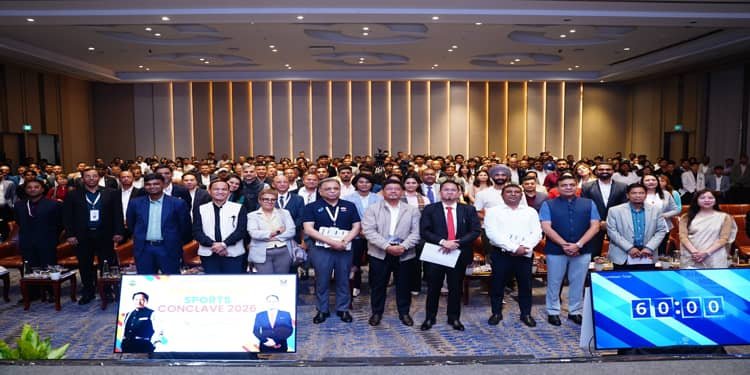
Shillong (Meghalaya), June 16: Meghalaya laid out its vision for a future-ready sports ecosystem today as the Sports Conclave 2026 ended with strong calls for governance reform, tech-driven athlete development, and deeper grassroots investment. The conclave, organised by the Department of Sports & Youth Affairs, drew Olympic medalists, policymakers, administrators and experts to Shillong with the 39th National Games now less than a year away.
The state showcased a ₹1,800 crore sports infrastructure push that is already reshaping its landscape. Highlights include the recently inaugurated ₹132 crore Integrated Multipurpose Indoor Sports Complex, upgrades to the J.N. Sports Complex and P.A. Sangma Integrated Sports Complex, and the ambitious ₹732 crore Mawkhanu Football Stadium. Designed to FIFA and AFC standards with 40,000 seats, Mawkhanu is set to be India’s first dedicated football stadium.

Three sessions drove the day’s agenda. The opening discussion on Transforming India’s Sports Governance featured Manu Bhaker and P.R. Sreejesh with policymakers and governance experts. The panel argued that policy must move beyond elite athletes and build inclusive systems from the ground up, with athletes having a direct say in decisions. Commissioner and Secretary Dr. Vijay Kumar D. pointed to Meghalaya’s community-led model, built on trust and local participation, as the foundation for its National Games preparations.
The second session tackled Innovation and Digital Transformation in Sports. World Athletics Vice President Dr. Adille Sumariwalla, Go Sports Foundation Board Member Deepthi Bopaiah, Olympic medallist Abhinav Bindra and RevSportz founder Boria Majumdar, with Bindra and Majumdar joining virtually, examined how data, analytics and partnerships are changing athlete development. The panel flagged Meghalaya’s sharp rise in sports allocations since 2018 as evidence of intent backed by investment.
The closing session on Holistic Development for a Sustainable Sporting Future brought Chief Secretary Dr. Shakil P. Ahammed together with athletes Manu Bhaker, Hima Das, Sheetal Devi, Harvinder Singh and P.R. Sreejesh. Sharing personal journeys, the athletes stressed the need for early talent spotting, stronger collaboration between governments, federations and institutions, and greater social recognition of sports as a career path.
With the National Games approaching, the conclave signaled Meghalaya’s shift from host to standard-setter. The state is betting that sustained funding, clear policy, and community ownership can turn sports into a transformative force for its youth and a template for the country.