


















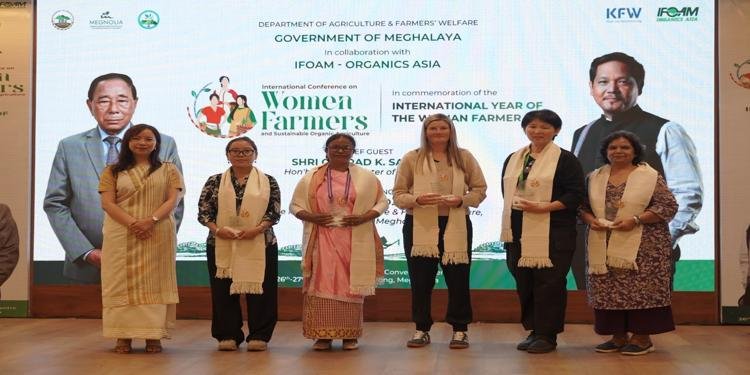
Shillong, June 27 : Meghalaya closed its two-day International Conference on Women Farmers and Sustainable Organic Agriculture by inking an MoU with IFOAM Organics Asia, aiming to turn the state’s matrilineal model into a blueprint for women-led organic farming.
About 400 delegates from over ten countries gathered at the State Convention Centre to mark the UN International Year of the Woman Farmer. The conference, themed “Women Farmers Leading Change Globally for Organic Food Systems,” was hosted by MEGNOLIA with IFOAM Organics Asia and KfW.
Agriculture Secretary Isawanda Laloo, in her closing address, said events like this are investments “in our farmers, our future, our children.” She credited Chief Minister Conrad K Sangma’s “deep-rooted connection to farmers and women” for driving the state’s organic push.
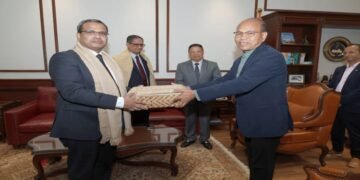
Delegates adopted a joint declaration on global organic standards after MEGNOLIA and IFOAM Organics Asia signed the MoU.
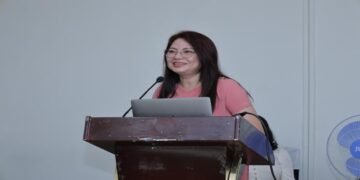
Day two featured “Cultivating Change: Inspiring Journeys of Women Organic Farmers,” with case studies from Japan, New Zealand, and Nepal. Padma Shree awardee Trinity Saioo said farmer collectives had made local women a “self-reliant economic force.” She thanked Prime Minister Narendra Modi for highlighting Lakadong turmeric at the G7 Summit, which “put the women of Meghalaya on the world map.”
On day one, the state launched Phase II of the Meghalaya State Organic Mission 2024–2028, bringing 44,000 more hectares and 46,000 small farmers under certified organic cultivation. Cheques worth ₹5.80 crore were also handed to Integrated Village Cooperative Societies in all 12 districts as the second tranche of organic input support.

The ₹295-crore, three-year Mission seeks to build Meghalaya into a global organic hub and shift women farmers into profitable value chains.
IFOAM Organics International President Karen Mapusua praised Meghalaya’s matrilineal structure, saying, “When a young woman in the Philippines or Taiwan sees women like those in this room leading with confidence, the whole agriculture future shifts.”
Sessions covered fair value chains, organic markets, and policy scaling. PRIME Rural presented its “doorstep incubation model” that has supported 290 enterprises and helped 166 rural women sell on Amazon and ONDC.
The meet ended with a field visit to Ri-Bhoi, where delegates toured women-led organic pineapple farms in Marngar and processing units at Eastern Ri Bhoi Organic FPC, interacting with SHGs and producer cooperatives.