























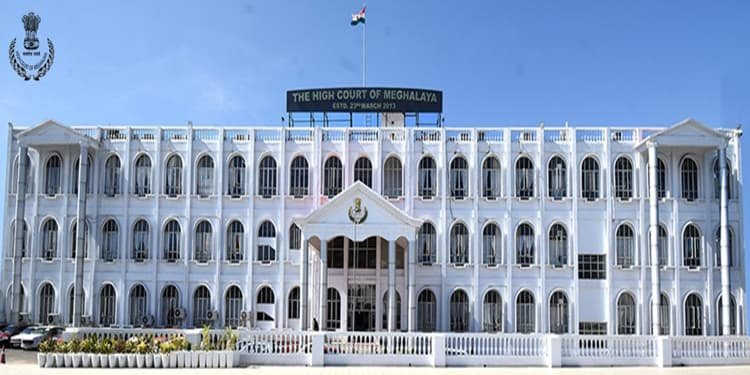
Shillong (Meghalaya), July 30: The Meghalaya High Court has intervened in a public interest litigation (PIL) to resolve disputes related to cemeteries and cremation grounds in the state. The court noted that different Christian denominations have their own cemeteries, but one religious order does not usually permit the dead from another denomination to be buried in its cemetery.
The Hindu, Khasi, and Jaintia communities cremate their dead, but there is a division between the Hindus and Khasi-Jaintia regarding sharing of crematoria. The Khasi and Jaintia communities want separate crematoria for themselves. To resolve these issues, the court appointed an Amicus Curiae to sit with all stakeholders, including the government and other public officials.
The court directed the Chief Secretary of the State to constitute a Committee comprising selected stakeholders to work towards a settlement between the Hindus, Khasis, and Jaintias, and between members of different Christian denominations. The court also directed that an acquisition of land drive may be undertaken to set up common cemeteries for members of various Christian denominations and cremation grounds for the different communities.

The Amicus Curiae informed the court that a meeting has already been held, and more meetings are likely to be held soon to resolve the dispute. Some members of the Hindu, Khasi, and Jaintia communities have agreed to share a common cremation ground, while others have expressed reservations.
The court accepted the suggestion of the Amicus Curiae that if others can be persuaded to follow the approach of sharing a common cremation ground, it would be beneficial. Otherwise, the Committee might consider acquiring land for cremation purposes. The court directed the Committee to convene and hold more meetings and arrive at a decision.
The public interest litigation has been listed for further hearing on August 14, 2025, and the Amicus Curiae has been requested to file a short report on the progress made by the Committee. The court’s order was passed by a bench comprising Chief Justice I.P. Mukerji and Justice W. Diengdoh.