






















Shillong, Sep 22: Accessibility is not charity. It is a right. And a door that needs another hand to open it is not accessible at all.
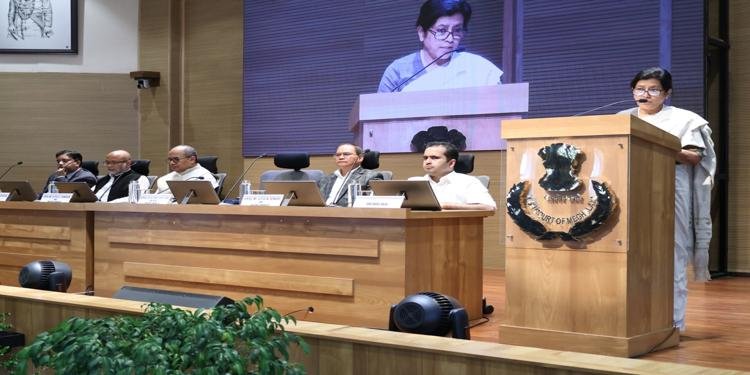
That was the blunt message from Chief Justice of Meghalaya High Court, Justice Revati Mohite Dere, on Tuesday as she called out the everyday barriers that keep persons with disabilities out of public life.
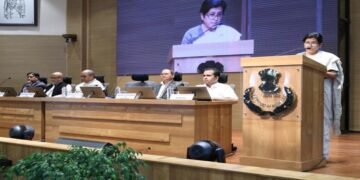
She was speaking at a high voltage sensitisation programme on making public buildings accessible under the Rights of Persons with Disabilities Act, 2016 at the High Court Auditorium.

The programme was organised by the High Court of Meghalaya along with the Commissioner for Persons with Disabilities, Vidhi Centre for Legal Policy and Mission Accessibility, New Delhi, on the directions of the Supreme Court.
Justice Dere did not mince words. The RPwD Act promises dignity, equality and zero discrimination. But on the ground, Supreme Court orders gather dust and persons with disabilities still struggle for the basics.
Why? Because we still don’t get it, she said.
“Lack of awareness, lack of sensitivity,” Justice Dere said, pointing to the real disability – in our mindset.
She said persons with disabilities are not looking for sympathy or favours. They want what we all want – to live with dignity, to be independent, to be self-reliant.
“Instead of empowering them, we disable them by building barriers,” she said.
Her solution: Fix it at the blueprint.
Engineers, architects, planners, officers who sanction plans – train them, sensitise them. Don’t add a ramp as an afterthought. Build inclusion from line one of the design. Bake universal design into every brick.
Accessibility, she said, should not be ticked off as a legal formality. It is a chance to make Meghalaya truly inclusive.
Imagine a child in a wheelchair who can’t enter his own classroom. A litigant who can’t enter a court. A citizen who can’t use a public toilet. That is not just inconvenient, it is unconstitutional.
“Schools, colleges, offices, courts – every public building must allow a person to move freely and with dignity,” Justice Dere said.
“People with disabilities succeed when institutions decide to be inclusive,” she added, urging a push from dependency to independence, from exclusion to confidence and participation.
And accessibility is not just a ramp. It is roads, footpaths, corridors, lifts, signage, workplaces, restrooms – everything we touch every day.
Her one-liner summed it up: “A door is not accessible if it needs another person to open it.”
She reminded officers that accessibility is the gateway to fundamental rights – right to life, right to education, right to justice. No access, no rights.
Commissioner and Secretary, Social Welfare, Pravin Bakshi, IAS, backed her up. Accessibility is law, not largesse, he said. It must be wired into building byelaws, plan sanctions, construction and upkeep.
He said Meghalaya has already audited 15 district courts and six jails and correctional homes to map barriers and fix them.
The power-packed session was attended by Justices H.S. Thangkhiew, B. Bhattacharjee and W. Diengdoh, top cops, Social Welfare officers and stakeholders, with expert talks on how to turn law into real, lived inclusion.