































Tura(Meghalya), April 20: Meghalaya Chief Minister Conrad K. Sangma on Monday laid out a single, hard bargain for the state’s farmers — take the seed, take the subsidy, take the factory, and finally take control of your income.
Addressing a full house at the Input Distribution Programme in SMELC, here, Sangma said more than 70% of Meghalaya runs on farming, yet growers stay trapped by late seeds, weak prices, and no processing. The fix, he argued, has to cover the whole chain or it isn’t a fix at all. Since 2022, the Ginger Mission has sent over Rs 62 crore to 19,000-plus farmers to reclaim Meghalaya’s lost lead in the crop.

Another Rs 15 crore this financial year will give 15,000 more growers 100 kg of free quality seed each, valued at Rs 8,000 per kit. Waiting to be cut open in Ri Bhoi is a Rs 20-crore ginger processing unit, the largest in the state, built to guarantee buy-back for nearly 10,000 farmers and stop the distress sales that crash prices every harvest.
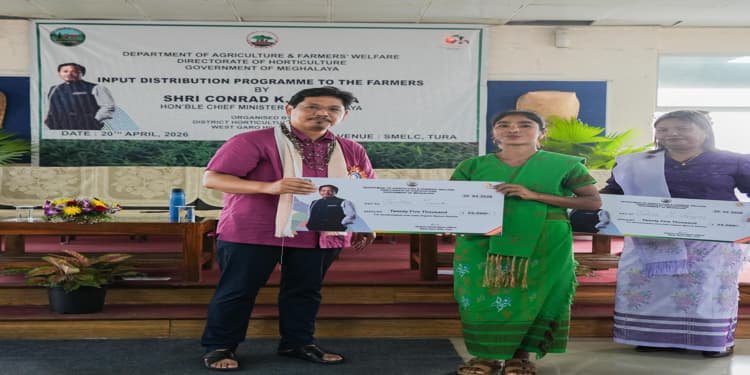
The handouts on Monday went beyond ginger. Farmers walked out with dummy cheques for vermicompost units under the Organic Manure Scheme, with the government picking up Rs 25,000 of the Rs 33,335 tab so they can make fertilizer on-site instead of chasing dealers. Anganwadi centres took home vegetable seed kits — seeds, tools, nets, watering cans — to build nutri-gardens for children. Officials said 11 of 40 sanctioned PRIME Hubs are already live, turning local pineapple, cashew, and ginger into packaged goods sold as Ge’am Gardens and Nokma through Meghalaya Collectives.
Sangma admitted the 2025–26 monsoon punished ginger with disease, forcing a course correction: mandatory seed treatment, planting only on rested land, and building disease-free seed stock inside the state. To cushion risk, 9,655 ginger growers in West Garo Hills are now under PM Fasal Bima Yojana with the state absorbing most of the premium.
The bigger bet is on high-value crops. CM Farm Plus has already paid up to Rs 5,000 each to 22,775 farmers who moved to black pepper, cardamom, cinnamon, vanilla, and avocado across 5,977 hectares since 2021. Garo Hills is being pushed as the state’s cocoa and vanilla zone, with 794 cocoa farmers on 650 hectares and 2,456 vanilla growers on 236 hectares already in the network. The All-Garo Hills Multipurpose Cooperative Society, 4,000 members strong, has aggregated over 800 MT from 8,000 farmers and returned better prices than the mandi.
“Use what we’re giving today,” Sangma told the crowd. “These aren’t freebies. They’re tools. Yield goes up, income goes up, and your farm lasts.”