
















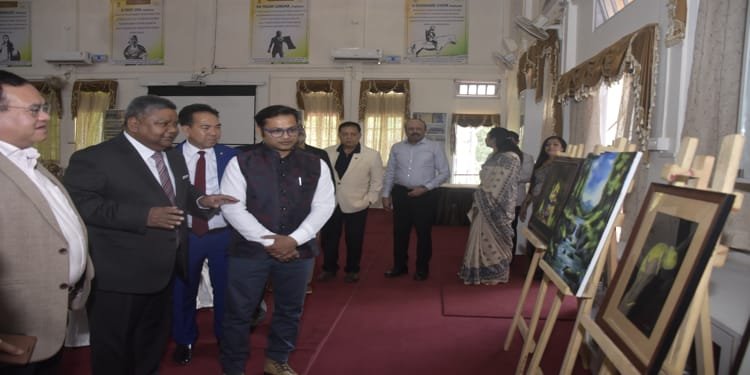
Shillong (Meghalaya), Apr 15: Lok Bhavan turned into a sanctuary of colour and conscience on Wednesday, April 15 as World Art Day 2026 unfolded with ceremonial grace. The occasion twinned a tribute to Leonardo da Vinci with a stirring commemoration of 150 years of Vande Mataram, the verse that once animated a freedom movement and now anchors cultural memory.
Artists of Padmashri Silbi Passah bookended the inaugural session with the song, each note threading past to present in a single breath of allegiance.
Chief Guest Charles Pyngrope, former Speaker of the Meghalaya Legislative Assembly, cast art as humanity’s oldest diplomacy and hailed Vande Mataram as protest rendered sublime. He described Shillong as an open-air atelier where hills curve like unfinished sketches and lauded the International Association of Art – India for scripting new chapters on that landscape. Arrayed beside him were Principal Secretary F. R. Kharkongor, Association President Manaj Saha, Brand Ambassador Biplap Roy, Adviser R. V. Warjri, and State Coordinator Raphael Warjri, the room alive with painters, patrons, and poets of form.

The Chief Guest unveiled a memorial exhibition featuring 40 artists from Meghalaya and beyond, where contemporary idioms conversed with ancestral motifs across canvases that refused to whisper. Manaj Saha argued that the North East’s calibre rivals any metropole, yet visibility and institutional spine remain unfinished work the Association vows to complete. Raphael Warjri, recalling Shillong’s colonial and post-Independence gravitas, lamented the absent gallery grid the city deserves and urged a structural renaissance to match its creative pulse.
The afternoon moved from pigment to thought. Dr. Meghali Goswami of Kala Bhavana traced Meghalaya’s artistic lineage with scholarly elegance. Digital visionary Shovin Bhattacharjee mapped India’s pixel frontier. Dr. Prakash Kishore narrated a cartography of migration that ended at his Shillong easel. Arak M. Sangma summoned the Garo Hills through folklore, song, and emergent traditions. Chief Electoral Officer Dr. B. D. R. Tiwari closed the dialogue by distilling Indian art to its philosophical marrow, finding in Vande Mataram the melody of a civilisation speaking to itself.
World Art Day 2026 thus became neither mere festivity nor nostalgia. It was audit and aspiration at once, a declaration that in Meghalaya the brush is both mirror and manifesto, and that a nation’s song still finds its clearest echo on a painter’s palette.